


The catch4climate project
In climate protection efforts, the primary objective is to avoid carbon dioxide (CO₂) emissions wherever possible. As carbon dioxide is inevitably released during the calcination of limestone – the principal raw material used in the production of cement as a binder – low-emission cement manufacturing can only be achieved in the long term if, alongside conventional CO₂ reduction measures, the CO₂ is successfully captured and either utilised as a raw material or stored.
To this end, the four European cement manufacturers – Buzzi SpA/Dyckerhoff GmbH, Heidelberg Materials AG, SCHWENK Zement GmbH & Co. KG and Vicat S.A. – joined forces in 2019 to establish the research company CI4C GmbH & Co. KG, with the aim of jointly implementing the ‘catch4climate’ CO₂ capture project at the cement plant in Mergelstetten. The facility, in which more than €120 million is being invested for construction and operation, will be the first to employ the so-called Pure Oxyfuel process for CO₂ capture. To this end, a dedicated rotary kiln line with a clinker production capacity of 450 tonnes per day is being constructed and will be used exclusively for research and development purposes.
Contacts
Dyckerhoff GmbH
Katja Gärtner
katja.gaertner@dyckerhoff.com
SCHWENK Zement GmbH & Co. KG
Lea Hemminger
lea.hemminger@schwenk.com
Heidelberg Materials AG
Conny Eck
conny.eck@heidelbergmaterials.com
VICAT
Raphael Hinninger
raphael.hinninger@vicat.fr
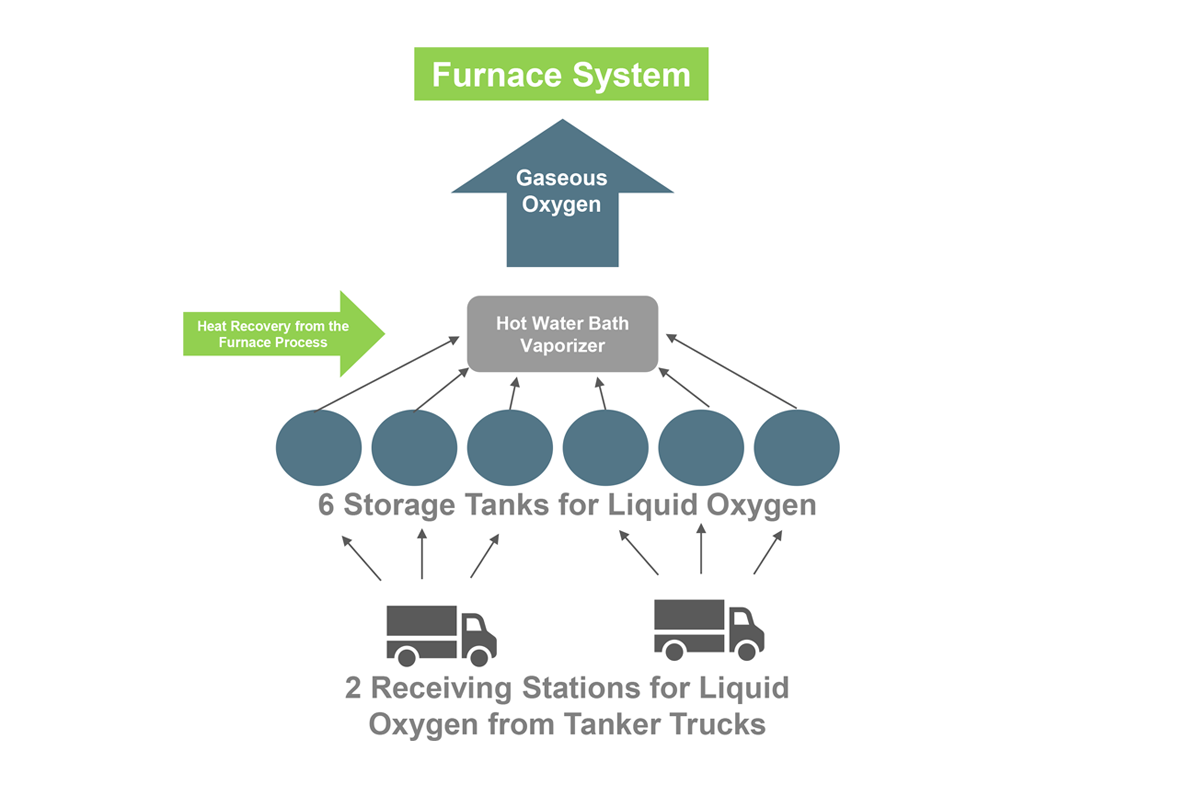
The oxygen required to operate the Oxyfuel kiln is delivered by established industrial gas suppliers in a cryogenic liquid state at approximately -183°C. The use of liquid oxygen reduces both transport and on-site storage volumes. Around 300–400 tonnes of liquid oxygen are stored on the plant site in six equally sized storage tanks approved for this purpose.
Gaseous oxygen is supplied to the Oxyfuel process via a warm-water bath vaporiser. To ensure energy-efficient operation of the vaporiser, heat is recovered from the kiln system. The gaseous oxygen is then delivered directly to the kiln system through a closed pipeline network.
CPU Plant – From Concentrated Gaseous CO₂ to a Liquid Product.
In the first stage, the cement kiln exhaust gas is cleaned in a gas scrubber within the CO₂ Purification Unit (CPU). Through compression and intercooling, the raw gas is processed into a low-pressure inert gas stream. Part of this inert gas is used primarily for fuel transport within the kiln system. The remaining gas is then directed to the subsequent compression and drying stage. Following further compression, trace gaseous components are removed.
A portion of this processed gas is returned to the kiln system as high-pressure inert gas, where it is used, for example, for cleaning filters and the preheater using air-blast devices. The remaining gas stream is fed into the CO₂ liquefaction stage, where the CO₂ is liquefied through partial condensation and distillation before being transferred to storage tanks. The refrigeration capacity required for liquefaction is provided by a closed two-stage ammonia refrigeration cycle.
Plant Safety
The 12th Federal Immission Control Ordinance (12th BImSchV) – Protection of People and the Environment
The Major Accident Hazards Ordinance is the Twelfth Ordinance implementing the German Federal Immission Control Act. It governs the protection of people and the environment from the consequences of sudden malfunctions in technical installations that may result in the release of hazardous substances, namely substances or categories of substances listed in the 12th BImSchV. The ordinance applies to all operational areas (e.g. production facilities and storage installations) in which hazardous substances are present above specified threshold quantities.
Operators of facilities covered by the ordinance are required to implement special safety measures to prevent major accidents from occurring, to identify any potential hazards immediately, and to respond appropriately. In this way, the impact on people and the environment can be minimised as far as possible.
Why does this plant fall under the scope of the 12th BImSchV?
The Oxyfuel plant presents fire and explosion hazards comparable to those of other cement kiln installations, as well as risks associated with the hazardous substances present on site, some of which fall within the substances or substance categories listed in the 12th BImSchV (Major Accident Hazards Ordinance). The plant falls within the scope of the 12th BImSchV solely because of the planned storage quantity of oxygen. As the facility is subject to the ordinance, other major-accident-relevant substances present on site, such as ammonia and heating oil, must also be taken into account.
Further information: CI4C Public Information on Major Accident Hazards (Seveso Information).
Protective Measures
Cover photo: Conné van d'Grachten
© 2024 CI4C GmbH & Co. KG